
Is Your Company Telling Five Different Stories?
Your website says you’re an innovator, but the user experience feels the same as it did in 2010.
Your sales team is talking about a product your customer service team barely knows exists.
Your investor materials highlight growth and improving margins while employees are experiencing pay or hiring freezes, unfilled positions, budget crunches or reductions in benefits.
Your executives are discussing cost management while your social channels are celebrating multimillion-dollar charitable investments or expensive conservation programs.
And your latest earnings call teased a major product launch or customer win that most of your employees heard about for the first time along with everyone else.
Individually, each message may be accurate. Together, they could be telling five very different stories about the same company. Worse, they may actually be undermining each other, leaving stakeholders questioning how the pieces fit together.
The problem isn’t simply inconsistent messaging. When the stories a company tells don’t align, it can create very real business problems — confused customers, employees who don’t understand priorities, sales teams making promises operations can’t support and stakeholders who begin to question the credibility of leadership.
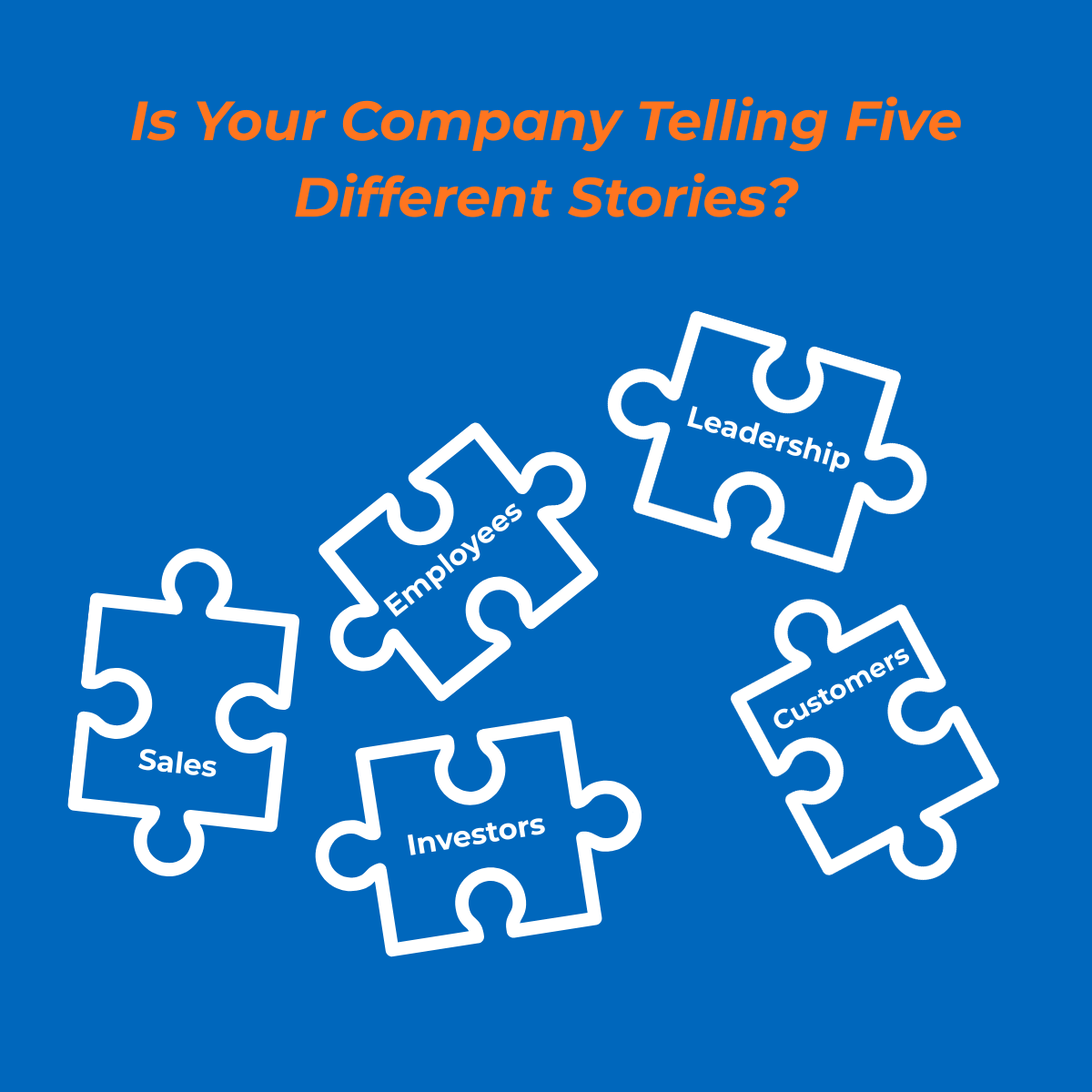
This happens more often than you might think, particularly in organizations that are in a time of change or rapid growth. Communications that once happened informally become distributed across departments. IT owns the website. Sales creates presentations. HR develops recruiting materials. Investor relations prepares earnings communications. Executives have their own presentations and talking points. Internal communications focuses on employees.
Before long, everyone is communicating — but no one is looking at the complete picture.
This is where corporate communications leaders become essential. Their role isn’t simply to make sure everyone is using the same talking points. It’s to understand the business strategy, see across functions and identify when what the company is saying — or doing — in one area conflicts with what it is trying to accomplish in another.
Internal and External Communications Don't Really Exist Anymore
I've talked before about the importance of starting communications strategy with the business plan. The same principle applies here.
In 2026, the distinction between "internal" and "external" communications is increasingly artificial. Employees are customers, shareholders, community members and potential brand advocates. Customers follow executives on LinkedIn. Job candidates read earnings reports. Investors see employee comments online. Employees see company announcements on social media.
Audiences overlap, and information travels.
That doesn't mean every audience should receive the same message. Far from it. Communications should be crafted specifically for the people you are trying to reach, keeping what matters to them in mind.
The key, though, is that different messages should still tell the same larger story and support the same business objectives.
Think of each of your company's communications as pieces of a puzzle. Each piece looks a little different and serves a specific purpose, but together they should create one larger, recognizable picture.
If your business strategy is creating a mountain landscape, an ocean-blue puzzle piece in the middle of it is going to stand out — even if that piece looks perfectly fine on its own.
Where Do the Gaps Show Up?
A few questions can help you identify where your company's story may be drifting:
Are you positioning the company around cutting-edge technology or product innovation while your customer experience feels a decade old?
Are you emphasizing growth and profitability to investors while employees are experiencing decisions that feel inconsistent with that message?
Are executives discussing acquisitions as a major growth strategy while employees don't know when companies have been acquired, why they were acquired or how they fit into the organization?
Are sales teams promoting products that are unavailable due to supply chain issues, being phased out or that customer service isn’t fully prepared to support?
Are your communications making promises about customer experience, innovation, culture or growth that your operations, people or technology aren't yet equipped to deliver?
The goal isn’t to make every message identical. It’s to identify where inconsistency creates confusion, undermines credibility or makes it harder for the business to execute.
Sometimes, the problem isn’t communications at all. Conflicting messages can expose larger business issues — unclear priorities, disconnected functions, operational gaps or leadership teams that aren't aligned on where the company is going. A good communications strategy won't fix those problems, but it can help identify them before your stakeholders do.
Strategic Content Planning Connects the Pieces
This is where a comprehensive communications strategy and thoughtful editorial calendar become much more than tools for deciding what to post next Tuesday.
They help organizations see the entire story.
As always, you should start with your business priorities. What does the company need to accomplish this year? What aspects of your reputation are you looking to strengthen? What do customers, employees, investors and other stakeholders need to understand for those goals to succeed?
From there, you can create several core themes or narratives that support those priorities. Those themes should become the foundation for monthly or quarterly content planning across your channels and audiences. Think focusing on innovation and growth as a kick off to your fiscal year, social responsibility efforts in April in conjunction with Earth Month, customer service highlights and feature during National Customer Service Week in October, safety commitments during National Safety Month in June, etc. Find the natural ebb and flow of your company’s year and tie them back to your business objectives.
Next, you need to look across your organization.
What is marketing saying? What is sales saying? What are executives talking about? What are employees hearing? What are you telling investors, candidates and customers?
Every piece doesn't have to say the same thing. It doesn’t even have to necessarily directly tie to the aforementioned themes as its vital you remain flexible as things naturally come up throughout the year. A good editorial calendar should provide direction, not handcuffs, but every piece of it must, however, have a reason for being there.
Don't Compete with Yourself
Companies are already competing for attention with competitors, industry organizations, influencers, news, social media and an endless amount of general noise.
You shouldn't also be competing with yourself.
Thoughtful communications planning helps ensure your next announcement doesn't undermine yesterday's executive message, your employee communications don't contradict your investor narrative and your sales team isn't telling customers a story the rest of the organization hasn't heard or can’t effectively support. More importantly, it helps ensure the story you’re telling reflects the business you’re actually trying to build.
Before you publish the next post, presentation, employee message or executive talking point, ask one more question:Does this piece help complete the picture we're trying to create — or does it belong to a different puzzle?